Wednesday, March 3, 2010
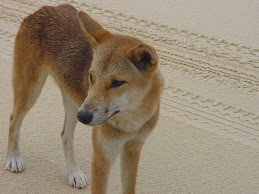
Fraser Island Dingoes 3/3/10
Last week Wildlife Bytes ran the story about Jennifer Parkhurst, the photographer who had her house invaded by DERM thugs early one morning last year. Jennifer now faces a maximum two years' jail or up to a $300,000 fine under the Nature Conservation Act and Recreation Area Management Act, for allegedly interfering with the Fraser Island dingoes. The real reasons for the raid were that, like many others, Jennifer has been highly critical of the Fraser Island dingo mis-management strategies, and in doing so she has upset the Queensland Government! Anyway, a rally or two are being planned, and a Fund has been set up to help Jennifer and the dingoes. People can contribute to the fund at Westpac Bank, Pialba, Hervey Bay. Save Fraser Island Dingoes Inc. BSB 034-136 Acct No. 303196.

Wednesday, December 30, 2009
Domestic Dog loose on Fraser Island. 30/12/09
Wildlife authorities fear an escaped cattle dog could spread a potentially deadly disease through Fraser Island's dingo population. The Queensland Parks and Wildlife Service (QPWS) says the cattle dog has not been sighted since escaping on Saturday from its home in Eurong, on the south of the island. Regional manager Rob Allan told AAP the escapee had been brought to the township illegally because domestic dogs are banned from the World Heritage-listed island. The QPWS said it was not searching for the dog because it could be anywhere. The Fraser Island Association says that in order to escape the dog would have had to breach a dingo fence surrounding the township. The association's president David Anderson said the fence was supposed to be electrified, but was ineffectual because it had been covered in sand for two months.
"The concern is, domestic animals can carry diseases and transmit them to dingoes that they come in contact with and the dingoes don't necessarily have immunity or resistance," Mr Anderson told AAP. "Potentially it is an ecological disaster. "It could wipe out or at least decimate the population of dingoes if there was a disease the dog was carrying." In the late 1970s, parvovirus spread by domestic dogs had a devastating impact on the island's dingo population. The virus can kill dogs and dingoes through gastrointestinal tract damage and dehydration. *9News
"The concern is, domestic animals can carry diseases and transmit them to dingoes that they come in contact with and the dingoes don't necessarily have immunity or resistance," Mr Anderson told AAP. "Potentially it is an ecological disaster. "It could wipe out or at least decimate the population of dingoes if there was a disease the dog was carrying." In the late 1970s, parvovirus spread by domestic dogs had a devastating impact on the island's dingo population. The virus can kill dogs and dingoes through gastrointestinal tract damage and dehydration. *9News
Tuesday, December 22, 2009
Fraser Island Dingoes close camping areas
Authorities have closed two beach campsites on Queensland's Fraser Island because of a threat posed by two packs of aggressive dingoes. The Department of Environment and Resource Management closed off One Tree Rocks and Cornwells campsites on the southern end of the popular tourist destination. DERM spokesman Terry Harper said rangers were closely monitoring several dingoes that had been behaving aggressively toward people. "There have been two groups of juvenile dingoes seen circling and entering these two campsites near Lake Wabby over the past few weeks," Mr Harper said in a statement. "We believe they present an unacceptable risk to visitor safety at this location." The sites can accommodate up to 200 people. Mr Harper said affected campers had been notified and told they could be accommodated at other sites on the island. People caught feeding or making food available to dingoes face penalties of up to $4000. *Brisbane Times
Ed Comment, perhaps now they might admit they got the dingo management wrong......
Ed Comment, perhaps now they might admit they got the dingo management wrong......
Thursday, December 17, 2009
Fraser Island Dingoes 18/12/09
Dingoes
Nearly 75 per cent of dingoes euthanised on Fraser Island had been eating human food, including steak, an Easter egg, cornflakes, sausages and commercial dog food. Of 92 dingoes , 59 had human food in their guts, with some having no natural food at all. Autopsies confirmed the views of rangers and conservationists - that people continue to deliberately feed the wild animals, discard food or leave it where dogs can get it. This leads to dingoes being put down because they see humans as a food source and become aggressive. Queensland Parks and Wildlife Service rangers have been struggling since the death of Clinton Gage in 2001 to convince visitors - and, particularly, island residents - that feeding is a critical issue in dingo bad behaviour.
Climate Change Minister Kate Jones said autopsies were carried out on dingoes that were put down or that died in other ways, such as being run over. ``It shows dingo feeding has occurred on the island for years, despite the best efforts of (rangers),'' she said. ``A large variety of human food, such as fruit, dog food, bones, beetroot and even a chocolate Easter egg (have been found).'' Island conservationist Mike West said the figures showed those feeding dingoes were creating a problem and it was up to the department to work out where it had gone wrong. The department had previously declared its public education program as ``world's best practice''. ``World's best practice?'' Mr West asked. ``It's closer to world's worst.'' He said most aggression incidents occurred when young dingoes tried to dominate children but the policy of putting them down was over the top. ``Domestic dogs often do this but there are no calls to shoot them,'' Mr West said.
Shark and crocodile deaths were not avenged while dingoes on Fraser Island faced capital punishment. Mr West said the environment would suffer if dingo numbers continued to decline. There were already signs of change, with big goannas commonplace and making pests of themselves inside areas fenced off by rangers. Mr West said the dingo -management plan was clearly not working. Autopsies identified starvation in only one dog while 65 per cent were in good condition with above-average weight. Ms Jones urged Christmas campers and residents not to feed dingoes and to be alert. ``Right now is the most influential time for young dingoes as they explore their surroundings, learn survival skills and adopt good or bad habits,'' she said. ``For this reason, it is vitally important that humans are not associated with food or seen as a food source.'' Fed dingoes expected food and then taught their pups to scavenge, often leading to aggression. People feeding dingoes or leaving food out could be fined up to $4000. Campers should stay close to children and set up camp in fenced areas.
Facts and tips * By not feeding dingoes , you help protect them * Lock away food in strong containers, dingoes will eat anything * Secure rubbish, bury fish offal at least 30cm deep to discourage scavenging * Leave tent wide open so dingoes can see there's no food * Naturally curious, dingoes will approach humans but they do bite * Dingoes are lightning fast - stay within 2m of children * Dingoes are almost as big as a German shepherd * Fraser Island is one of the best places to see pure dingoes * Inbreeding with domestic dogs is threatening their survival * An important predator, they keep the environment in balance * Keep rabbit and feral cat numbers down * Naturally lean, some are sandy-yellow, others black and tan *Courier Mail
Ed Comment; Lots of misinformation in this article above . For a start, Freedom of Information documents have shown that most of the dingoes that have been killed have empty stomachs. We've said it before and we say it again, the Fraser Island Dingo Managment Plan is the worst wildlife management blunder ever committed in Queensland. The Queensland Government claims that dingoes are "naturally skinny" which is nonsense.....a skinny dog is a hungry dog, and thats why people feed them....and they willl never stop that from happening......noone likes to see a starving dog...except the Queensland Government!
Nearly 75 per cent of dingoes euthanised on Fraser Island had been eating human food, including steak, an Easter egg, cornflakes, sausages and commercial dog food. Of 92 dingoes , 59 had human food in their guts, with some having no natural food at all. Autopsies confirmed the views of rangers and conservationists - that people continue to deliberately feed the wild animals, discard food or leave it where dogs can get it. This leads to dingoes being put down because they see humans as a food source and become aggressive. Queensland Parks and Wildlife Service rangers have been struggling since the death of Clinton Gage in 2001 to convince visitors - and, particularly, island residents - that feeding is a critical issue in dingo bad behaviour.
Climate Change Minister Kate Jones said autopsies were carried out on dingoes that were put down or that died in other ways, such as being run over. ``It shows dingo feeding has occurred on the island for years, despite the best efforts of (rangers),'' she said. ``A large variety of human food, such as fruit, dog food, bones, beetroot and even a chocolate Easter egg (have been found).'' Island conservationist Mike West said the figures showed those feeding dingoes were creating a problem and it was up to the department to work out where it had gone wrong. The department had previously declared its public education program as ``world's best practice''. ``World's best practice?'' Mr West asked. ``It's closer to world's worst.'' He said most aggression incidents occurred when young dingoes tried to dominate children but the policy of putting them down was over the top. ``Domestic dogs often do this but there are no calls to shoot them,'' Mr West said.
Shark and crocodile deaths were not avenged while dingoes on Fraser Island faced capital punishment. Mr West said the environment would suffer if dingo numbers continued to decline. There were already signs of change, with big goannas commonplace and making pests of themselves inside areas fenced off by rangers. Mr West said the dingo -management plan was clearly not working. Autopsies identified starvation in only one dog while 65 per cent were in good condition with above-average weight. Ms Jones urged Christmas campers and residents not to feed dingoes and to be alert. ``Right now is the most influential time for young dingoes as they explore their surroundings, learn survival skills and adopt good or bad habits,'' she said. ``For this reason, it is vitally important that humans are not associated with food or seen as a food source.'' Fed dingoes expected food and then taught their pups to scavenge, often leading to aggression. People feeding dingoes or leaving food out could be fined up to $4000. Campers should stay close to children and set up camp in fenced areas.
Facts and tips * By not feeding dingoes , you help protect them * Lock away food in strong containers, dingoes will eat anything * Secure rubbish, bury fish offal at least 30cm deep to discourage scavenging * Leave tent wide open so dingoes can see there's no food * Naturally curious, dingoes will approach humans but they do bite * Dingoes are lightning fast - stay within 2m of children * Dingoes are almost as big as a German shepherd * Fraser Island is one of the best places to see pure dingoes * Inbreeding with domestic dogs is threatening their survival * An important predator, they keep the environment in balance * Keep rabbit and feral cat numbers down * Naturally lean, some are sandy-yellow, others black and tan *Courier Mail
Ed Comment; Lots of misinformation in this article above . For a start, Freedom of Information documents have shown that most of the dingoes that have been killed have empty stomachs. We've said it before and we say it again, the Fraser Island Dingo Managment Plan is the worst wildlife management blunder ever committed in Queensland. The Queensland Government claims that dingoes are "naturally skinny" which is nonsense.....a skinny dog is a hungry dog, and thats why people feed them....and they willl never stop that from happening......noone likes to see a starving dog...except the Queensland Government!
Wednesday, November 25, 2009
Eyewitness report from Fraser Island 20/11/09
Eyewitness report from Fraser Island
"I understand that DERM recently announced as part of their management strategy for FI, that dingoes would be discouraged (by hazing) from walking along the beach before 5pm and after 5am, in an attempt to keep them away from people.
This evening, at 5.45 pm, during an evening walk along the beach on FI I saw a young dingo bitch and her puppy patrolling the high tide line (clearly they have learnt the new rules). The bitch went over the dune and disappeared, but the pup lingered on the dune and was still visible from the beach but simply minding its own business when it was spotted by a ranger’s vehicle. The rangers stopped instantly, did an extremely tight u-turn and hazed the pup with a slingshot. The pup was hit, the shot frightened the life out of it, and it disappeared over the dune. The rangers then tore off down the beach.
I went over to investigate; it seemed the pup had run into a swamp type area and was howling. The bitch appeared and looked extremely concerned. She must have witnessed the event, and seemed too scared to come out of her hiding place to find her pup, which continued to howl.
If this is not disrupting pack structure, I don’t know what is. If this is not sport, I don’t know how else to describe it. Might I also add that the bitch had an ear that was tagged so badly the ear was drooping to the point of being closed, and it looked like some debris was lodged in the tag.
The bitch went in search of her pup, and I was left wondering what the management of Frazer island has come to, that innocent creatures are no longer allowed, within their DERM-allocated time slot, to go about their usual behaviors. There were a few other people on the beach at the time, I hope they didn’t see the disgraceful way that the rangers behaved towards our island’s most valuable tourist draw-card."
Ed Comment; This disgracefull behavior by FI Rangers against the dingoes is inexcusable. In spite of a decade of the community expressing concern to Government about the treatment of dingoes on Fraser Island, its all fallen on deaf ears.
"I understand that DERM recently announced as part of their management strategy for FI, that dingoes would be discouraged (by hazing) from walking along the beach before 5pm and after 5am, in an attempt to keep them away from people.
This evening, at 5.45 pm, during an evening walk along the beach on FI I saw a young dingo bitch and her puppy patrolling the high tide line (clearly they have learnt the new rules). The bitch went over the dune and disappeared, but the pup lingered on the dune and was still visible from the beach but simply minding its own business when it was spotted by a ranger’s vehicle. The rangers stopped instantly, did an extremely tight u-turn and hazed the pup with a slingshot. The pup was hit, the shot frightened the life out of it, and it disappeared over the dune. The rangers then tore off down the beach.
I went over to investigate; it seemed the pup had run into a swamp type area and was howling. The bitch appeared and looked extremely concerned. She must have witnessed the event, and seemed too scared to come out of her hiding place to find her pup, which continued to howl.
If this is not disrupting pack structure, I don’t know what is. If this is not sport, I don’t know how else to describe it. Might I also add that the bitch had an ear that was tagged so badly the ear was drooping to the point of being closed, and it looked like some debris was lodged in the tag.
The bitch went in search of her pup, and I was left wondering what the management of Frazer island has come to, that innocent creatures are no longer allowed, within their DERM-allocated time slot, to go about their usual behaviors. There were a few other people on the beach at the time, I hope they didn’t see the disgraceful way that the rangers behaved towards our island’s most valuable tourist draw-card."
Ed Comment; This disgracefull behavior by FI Rangers against the dingoes is inexcusable. In spite of a decade of the community expressing concern to Government about the treatment of dingoes on Fraser Island, its all fallen on deaf ears.
Monday, November 16, 2009
Dingoes 12/11/09
Fraser Island dingo protection activists have asked questions in the Queensland Parliament relating to Dr Laurie Corbett's qualifications to undertake an "independent" audit of the Fraser Island dingoes. Corbett devised the origonal Fraser Island Dingo Management Plan that has been widely criticised, and has accounted for the deaths of many of the Islands dingoes. He has just completed a so-called "independent" audit which claims every thing is okay, and the Management Plan is working! We suppose it all depends on what the Plan is meant to accomplish.......
Monday, November 2, 2009
Alpine Dingoes
A pair of rare alpine dingoes is heading north to call the Fraser Coast home. TESS Wildlife Sanctuary supervisor Ray Revill said yesterday that Queensland’s Department of Environment had told him this week that he could bring the dingoes from Victoria providing he built the fenced enclosure “according to our rules”. “I just have to raise the money to build the dingoes’ new home and I need to pay $600 to the wildlife sanctuary down south to buy the pups and $240 to fly them up here.” The dingoes, a male and female, are three months old. “One is reddish-blond and the other black and tan. They are both beautiful dogs and DNA tests done on them show they are pure dingo. There’s no dog in them at all.” Mr Revill said he had tried to convince EPA to let him have a couple of Fraser Island dingoes for his sanctuary “for educational purposes”. But they told me those dogs over there had never been successfully held or able to breed in captivity. “I was a ranger on the island for over seven years so I dispute that but rules are rules.”
The alpine dingo, a sub-species of the dingo, is on the verge of extinction. Former CSIRO dingo specialist Alan Newsome, who led the last investigation undertaken on the dingo more than 20 years ago, said in the late ’90s that the dingo was slowly but surely being wiped out as a result of cross-breeding or hybridisation with domestic breeds of dog that had turned feral. Les Hall of Griffith, one of only three breeders of alpine dingo in New South Wales at the time, said there were only 10 breeding pairs of the alpine dingo left in captivity in New South Wales and 25 in Australia. Estimates of wild alpine dingoes vary at around the 150 mark. Biologists consider a species to be extinct when there are fewer than 500. *Fraser Coast Chronicle
Ed Comment; Unfortunately the NSW Government has been aerial dropping 1080 poison over the alpine dingo habitat, to protect sheep farmers from stock losses. Like so many other species of wildlife, the Australian dingo is unlikey to survive in the wild, especially the alpines.
The alpine dingo, a sub-species of the dingo, is on the verge of extinction. Former CSIRO dingo specialist Alan Newsome, who led the last investigation undertaken on the dingo more than 20 years ago, said in the late ’90s that the dingo was slowly but surely being wiped out as a result of cross-breeding or hybridisation with domestic breeds of dog that had turned feral. Les Hall of Griffith, one of only three breeders of alpine dingo in New South Wales at the time, said there were only 10 breeding pairs of the alpine dingo left in captivity in New South Wales and 25 in Australia. Estimates of wild alpine dingoes vary at around the 150 mark. Biologists consider a species to be extinct when there are fewer than 500. *Fraser Coast Chronicle
Ed Comment; Unfortunately the NSW Government has been aerial dropping 1080 poison over the alpine dingo habitat, to protect sheep farmers from stock losses. Like so many other species of wildlife, the Australian dingo is unlikey to survive in the wild, especially the alpines.
Subscribe to:
Posts (Atom)